is fashion wearing out the world? a book summary
Written June 2013
Introduction
In 1995, I was adopted to the US from Kunming, China and recently learned of a protest that drew nearly 2,000 citizens to Kunming's city center. The subject of the protest; the construction of a chemical plant commonly used in textile production. A friend in Kunming I met last fall told me that the air pollution there is getting worse. For all that my birthparents have done to ensure my survival, I owe it to them, in some abstract way, to ensure theirs. However, it should not take a personal connection for me to care about the livelihoods other humans.


In order to understand why “eco-friendly” buzzwords have emerged within the context of clothing, the current condition of the fashion industry must be addressed. Fashion consumption, as I detail in subsequent sections of this post, is deeply embedded in and around our global agricultural, infrastructure, transportation, and distribution systems. While there is no way to mass-manufacture products without generating some form of waste, there are viable ways to minimize the damage. I've created this page as a way to share a few insights about this industry I’m involved in, and nearly everyone contributes to. The majority of this research is taken from “To Die For: Is Fashion Wearing Out the World” by journalist Lucy Siegle and some supporting text is from “Future Fashion White Papers” introduced by Leslie Hoffman, and "Where Am I Wearing” by Kelsey Timmerman. These authors have done tremendous work to publicly push discussions about fashion towards responsible production and consumption practices.
Yet, I’m constantly reminded that sustainability options are still in their infancy. A couple months ago, I walked into my local Nordstrom’s (downtown Seattle location) and asked a sales floor rep where I could find garments with organic cotton, or ethical supply chain certifications. Her puzzled stare and “do you mean pima cotton?” reply shows how slowly the retail industry moves, and how inaccessible an alternate choice can be for the every day consumer.
Additionally, any fashion brand that is willing to take a business risk on a novel sourcing/manufacturing method (and/or verify the transparency of their supply chain through a series of costly certifications) typically has to sell the product to consumers at a premium. When sustainable product options are not economically viable options for individuals, simply sharing information and pressuring companies to revise exploitative practices are realistic ways to advance the conversation.
In a sustainable future, “sustainability” won’t have to be labeled as exclusive or niche, but as a cohesive way of life.
FAST FASHION

http://blog.vegas.com/wp-content/uploads/2010/08/forever21main.jpg
While trendy, environmentally-conscious slogans have popped up on everything from designer tote bags to toddler onesies, the ethical implications, namely the labor behind these products are largely ignored. Increasingly, I hear news about Western heritage companies moving their production overseas to countries with little to no labor protection and ineffective policy enforcement. When retail buyers demand factory suppliers to complete massive orders at nearly impossible turn-around times and for lesser pay, suppliers are forced to accommodate to the buyer's demands. As a result, the production workers in factories are subject to unsafe labor conditions and wage exploitation.
Since the introduction of this cheap, “fast fashion” model, consumer behavior has shifted. Rather than examining the quality of the fiber content or construction, marketing tactics have diverted consumer attention solely towards the price tag. In order for the future of sustainable fashion to thrive, consumers must be convinced that the value of buying one or two quality products per year outweighs armloads of cheap clothing. Ultimately, the power to revise a company's practice rests with the consumer as every purchase a consumer makes (or refuses to) is a vote for or against the continued success of the brand.
CASHMERE
Because of fast fashion's demand, textile production has doubled since the 1990’s. It is easy to overlook that many of the clothes we wear are extracted from plants and animals, with each species requiring specific ecological conditions to produce optimal fiber.

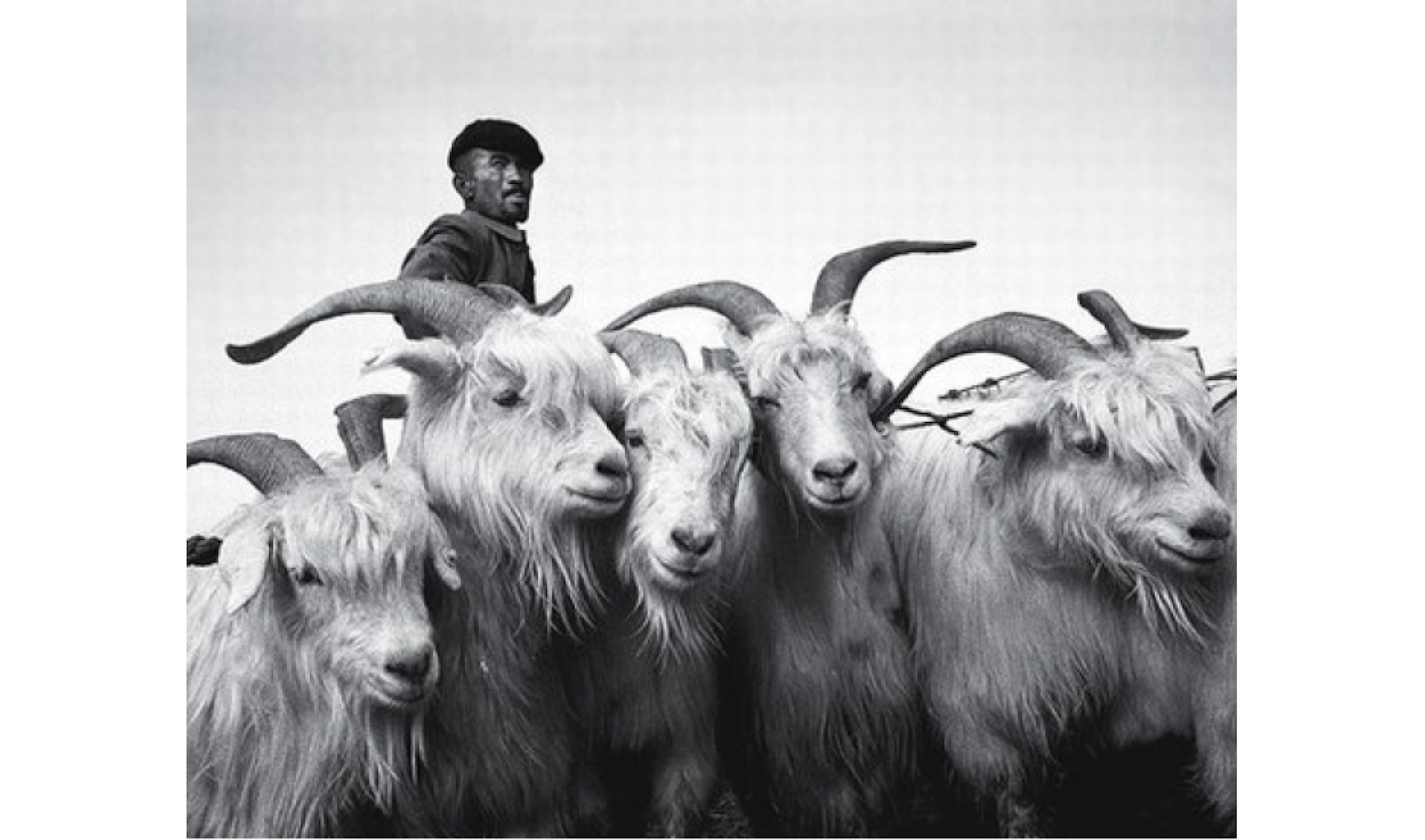
Cashmere comes from nomadic herdsman in Asia. The goats are rare and harvesting is a difficult process. The Alashan Plateau in Mongolia, where 20% of the world’s cashmere comes from, is also home to the world’s largest sand dunes. These enormous sand dunes are held in place by the plants that grow there. In small herds, the cashmere goats live in harmony with the ecosystem. However, to satisfy the desire for cheap cashmere, the number of goats have multiplied from 2.4 million in 1990 to 26 million in 2004. Due to overgrazing, sections of the desert are now expanding by 400 square miles per year. China suffers from many dust storms from the displaced sand, which continues to travel over the Pacific Ocean and contributes to pollution in major cities along the West Coast in the US. Because of mass-market pressure for cashmere, some herders crossbreed their goats to produce cashmere faster but results in poorer quality fiber.
http://foggie.org/mongolia/2-Scan-120523-0026%20copy.jpg
Brands that strive to make a difference for the lives of these Mongolian herders use pure cashmere from suppliers who support sustainable cashmere trade. For example, the knitwear brand Stewart and Brown works with selected farmers in Mongolia, guaranteeing a fair price for cashmere from a limited number of goats processed through an ethical chain. Sustainable cashmere is expensive, but it will last from 20 to 40 years. Many traditional cashmere brands will repair and reshape their customer’s product for if it starts to look a bit worn. In the future, I hope to see fashion brands adopt personal connections with their customers in order to stress the importance of treating clothing as a long-term investment.
COTTON

http://3.bp.blogspot.com/_sv_SOl1hq70/S8xiYbHPcZI/AAAAAAAABvs/z-B6mdMlfuw/s1600/mali-cotton.jpg
Cotton is essential to fashion as the industry uses 80-90% of all the cotton produced. The production for cotton alone employs 300 million people, and 99% of them work in developing countries. There are numerous problems with cotton, one of which being its heavy dependency on water, but the most important issue is its pesticide use. It takes 1/3 a pound of pesticides and chemical fertilizers to produce a single t-shirt. Aldicarb is the second most prevalent pesticide in the cotton industry and just one drop absorbed through the skin is enough to kill an adult human. Because of the deaths associated with these chemicals, many Western countries have banned their use, causing the agrichemical companies to advertise their products to developing countries. For many farmers, the low prices for cotton and high prices for the chemicals have caused thousands of farmers to go bankrupt and in India, which uses 50% of all global pesticides, there have been more than 20,0000 cotton farmer suicides since 1995. Before 2008, the US was the #1 exporter of cotton since 1834. Because US cotton is the second most subsidized agricultural product, it is sold below the cost of production. Therefore, suppliers from developing countries cannot compete on the international market and are condemned to poverty. Siegle claims that a removal of subsidies would increase sub-Saharan cotton growers’ income by 30%.

https://en.wikipedia.org/wiki/File:AralSea1989_2014.jpg
Another ecological setback with relying on cotton is that it requires more water than almost any other textile crop. The Aral Sea, a freshwater lake in Central Asia, supported an enormous fishing industry and tourist destination. Then in the 1960’s water had been diverted to feed giant cotton plantations and within three decades, over 70% of the lake had completely vanished, leaving an unrecognizable, barren landscape in its wake. The local economy was effectively destroyed and many residents who relied on the lake for their source of food, water, and income developed serious respiratory problems due to the pesticide residue combined with the dry atmosphere.
Because disasters like the Aral Sea are attributed to manufacturers that capitalize on cheap cotton, organic cotton has been introduced as an alternative for designers to work with. Organic cotton is free of pesticides and often planted in crop rotation which increases soil fertility. Environmentally conscious brands like People Tree have used cotton without pesticides from their inception, and in 2007 the idea of organic cotton was pushed mainstream when Levi’s introduced a new line of 100% organic jeans. Organic cotton still only accounts for less than 1% cotton production worldwide, but the global retail sales have increased from $1 billion to 7 billion just in the last few years and it is expected that number will keep growing as more people realize its importance. The rise of other sustainable fibers like hemp, soy silk and lyocell and 21st century innovations like digital printing, water-free washing, and air dye technology are also paving the way for exciting new sustainable prospects.

http://about.hm.com/content/dam/hm/about/images/en/Editorial%20images/Top%20images/cotton.jpg/_jcr_content/renditions/cq5dam.web.648.486.png
DISPOSAL
Every year, over 300,000 tons of garments are donated to thrift shop. However, only 52% are a high enough grade to be marketable as the fast fashion model has degraded the overall quality of clothing. Clothes that are deemed unsellable are then packed up and shipped to developing countries to be resold. This system is an enormous billion dollar business for Western countries and works in their favor as a useful, cost-efficient dumping ground for unwanted goods

http://www.anorak.co.uk/wp-content/uploads/2014/05/PA-19273262.jpg
Mass exports of unwanted goods began in the 1990s, concurrent with the emerging success of the fast fashion's model. Bales filled with worn, damaged, or unsanitary clothing are resold - the most likely recipients are stallholders in sub-Sahara Africa- who then resell the products to their community. Because Western imports are sold at a lower price than locally made clothing, domestic clothing and textile industries in many of these regions have collapsed. In order to preserve traditional, time-honored textile techniques, companies like AFIA, Fortress of Inca, and VOZ work with artists in developing regions to produce contemporary clothing and footwear that support cultural craft traditions.
THE FUTURE OF A SUSTAINABLE WORLD
In summary, the future of sustainable fashion is comprised of the following elements: a responsible supply chain, environmental stewardship, social justice, and consumer education. Fashion is an industry that touches every individual and questioning our individual consumption habits is absolutely necessary to change the way finite resources are consumed on a global scale. I’m curious to see how sustainable product conversations continue amongst industry professionals and in general public discourse. For those seeking an engaging, informative entry point on this subject, Lucy Siegle’s book is a great place to start.

Further Resources
2018 update: Many links are now out of date or have migrated to different platforms
For a list of ethical clothing brands, check out a few of my favorite places here.
Other resources and up-to-date articles, you can check out blogs like Ethical Consumer, The Good Trade, Ecouterre. Trash Is For Tossers, Life + Style + Justice, The Note Passer, Sustainably Chic, and Ecocult to name a few.
other articles Referenced:
http://highline.huffingtonpost.com/articles/en/the-myth-of-the-ethical-shopper/
http://www.huffingtonpost.com/natalie-grillon/ethical-shoppers-were-not-a-myth_b_7868032.htm
http://www.1millionwomen.com.au/blog/a-z-glossary-of-sustainable-fibres/